


Non-invasive prenatal testing (NIPT) using cell-free DNA (cfDNA) has transformed prenatal screening and care over the last decade. Nowadays, cfDNA-based NIPT has evolved into a central tool for early and accurate risk assessment of common fetal chromosomal aneuploidies, reshaping how clinicians counsel expectant parents, how laboratories deliver services, and how healthcare systems plan prenatal pathways.
Below, we explain the science behind cfDNA, why NIPT offers accuracy advantages over older approaches, and how Revvity’s Vanadis® NIPT system helps laboratories offer precise, scalable, and cost-effective screening.
What is cfDNA and how does NIPT work?
During pregnancy, short fragments of DNA circulate in the mother’s blood plasma. A fraction of this cell-free DNA originates from the placenta and reflects the fetal genome. NIPT analyses these cfDNA fragments to detect over- or under-representation of whole chromosomes (most commonly chromosomes 21, 18, and 13) and, in some workflows, selected sex-chromosome abnormalities (SCAs), such as Turner (45,X) or Klinefelter syndrome (47,XXY).
Different laboratory approaches exist to measure cfDNA (e.g., massively parallel sequencing, targeted sequencing, SNP-based methods, and non-PCR methods). Revvity’s Vanadis® cfDNA platform uses a rolling circle replication and digital molecular counting approach that reduces complexity by avoiding PCR and sequencing while still delivering high precision and reproducibility for common trisomies.
Why NIPT is more accurate than conventional screening
Traditional first-trimester screening (NT ultrasound + serum biochemistry) provides useful risk estimates but has inherent limits in sensitivity and positive predictive value. In contrast, cfDNA-based NIPT delivers substantially higher detection rates for trisomy 21 (Down syndrome) — often above 99% sensitivity with very low false positive rates — and generally improved performance for trisomies 18 (Edward syndrome) and 13 (Patau syndrome) as well. Multiple meta-analyses and clinical studies have confirmed that all major NIPT methods greatly outperform standard combined screening in sensitivity and specificity for common fetal aneuploidies.
Practical benefits of the increased accuracy include:
- Fewer false positives and therefore fewer unnecessary invasive procedures (chorionic villus sampling or amniocentesis).
- Lower overall anxiety and clearer counseling pathways for parents.
- High negative predictive value that can reassure low-risk pregnancies.
Revvity’s Vanadis® NIPT approach: accessible, automated cfDNA testing
Revvity’s Vanadis® NIPT system is designed to make cfDNA testing more accessible and cost-effective for laboratories. Key aspects include:
- Non-PCR, molecular counting workflow: Vanadis uses rolling circle replication and fluorescent molecule counting rather than PCR and high-depth sequencing, simplifying the assay workflow and reducing dependency on complex sequencing infrastructure.
- Automated platform: The Vanadis ecosystem (Extract, Core, View instruments) automates extraction, processing, and imaging/counting steps, which helps standardize performance and reduce manual variation.
- Scalability and cost control: By removing the need for sequencing and streamlining processes, Vanadis can lower per-sample costs and bring high-precision screening within reach of more laboratories and healthcare systems.
- Integrated software: LifeCycle™ software supports risk calculation, sample tracking, and quality dashboards — helping labs manage throughput and reporting with clinic-grade traceability.
Revvity also supports labs with reference materials (e.g., Mimix™ NIPT standards) and services that help with validation and implementation, both important elements for labs launching or expanding NIPT services.
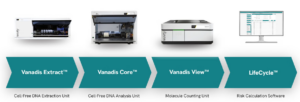
Image: VANADIS NIPT Workflow, sourced from Revvity’s website
What this means for patients and health systems
The practical outcome of more accessible, high-quality NIPT is the wider availability of early, reliable risk assessment for pregnant people. This enables:
- Earlier and better-informed counseling and decision-making.
- Reduced need for invasive testing in many cases.
- More equitable access to advanced prenatal screening across regions and care settings.
For health systems, cost-effective NIPT platforms that maintain clinical performance can support broader screening programs, potentially improving population health outcomes while containing costs.
How The Science Support can help your lab
At The Science Support, we partner with laboratories to implement robust prenatal screening workflows. We can support you with:
- Product selection (e.g., Vanadis® NIPT system and ancillary reagents), validation planning and method comparisons.
- Integration of LifeCycle™ software for sample and data management.
- Access to reference standards and implementation support.
Read more about all our integrated solutions that will help you make informed decisions in the field of perinatal medicine.